Fetal movement insights
Fetal movement myths buster
Something sweet, a walk up the stairs, ten kicks in two hours - do these common beliefs about babies' movements hold up? We look at the evidence.

Niamh Nowlan, PhD
Co-Founder & CEO, Maternitec
- Published
- Read time
- 4 min
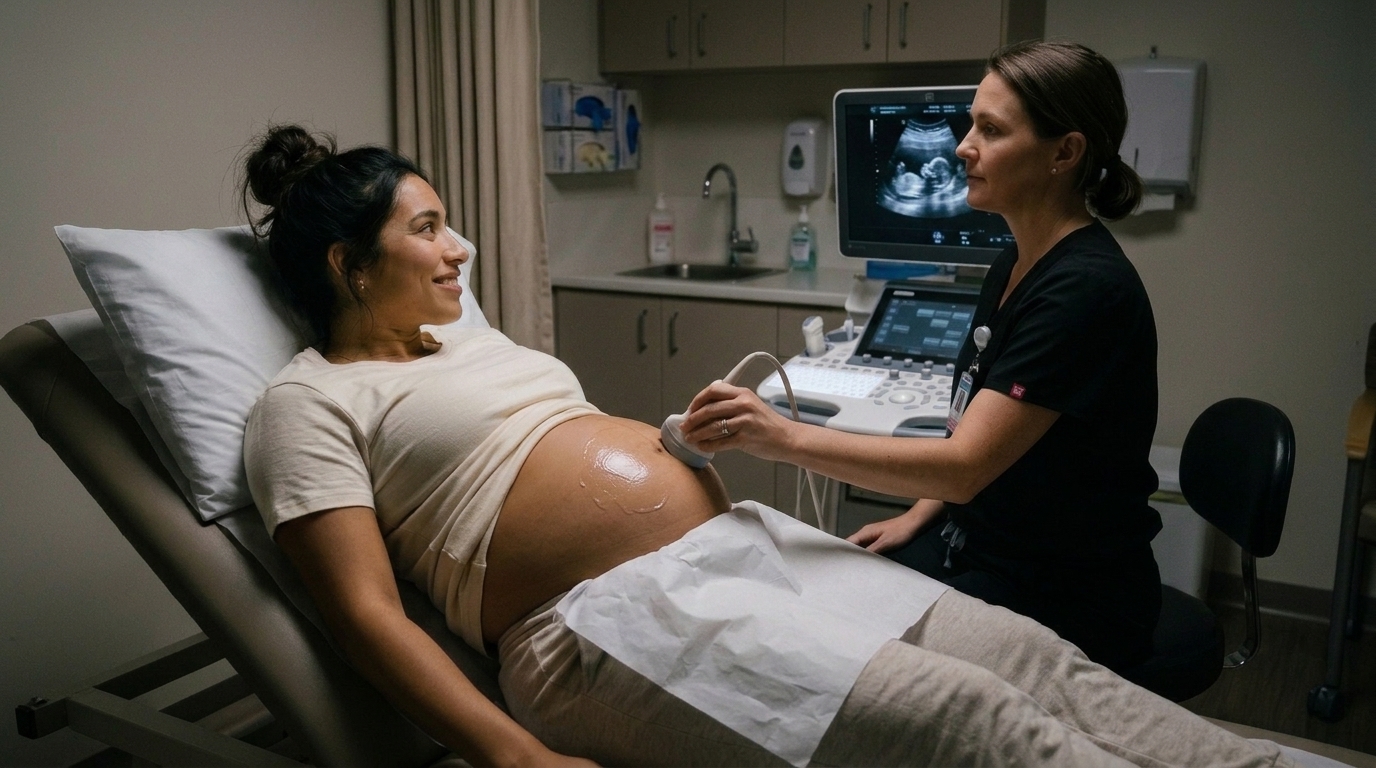
During our middle son's 20-week scan, the little guy stayed resolutely in the same position, which meant some essential checks couldn't be done. I was told to walk up and down some stairs and eat something sweet. I was sceptical that either would wake him before he was good and ready, but I followed the advice anyway. By the second scan an hour or so later he had turned - but would he have moved anyway, without the sugar or the steps?
Let's look at some common beliefs about babies' movements in the womb, and see how many hold up to scrutiny.
Waking baby: a spoonful of sugar?
Often a baby will need to move position during an ultrasound and there are different tips for waking a quiet baby, including iced water, something sugary or a walk. Sugar is the one thing that's been properly tested. In a Turkish trial, 180 women whose baby's heart rate trace hadn't shown the healthy speed-ups staff look for were given dark chocolate, orange juice or nothing, and then rested for 30 minutes. Neither treat made a real difference to the repeat trace, or to whether women felt more movement.[i] A sugar drip didn't help either, in a trial of women worried about reduced movements.[ii] When a New Zealand study asked 274 women how strongly their baby moved in different situations, a cold drink, a meal, a walk and a poke of the bump all came off worse than simply sitting quietly.[iii]
The one thing that does work is a combination of vibration and sound - but in hospital. If a baby seems to be asleep during a heart rate trace, staff may place a small device on the bump that gives a brief buzz with vibration and sound (vibroacoustic stimulation, or VAS). This cuts the number of these "sleepy" traces by more than a third.[iv]
So what about our son? Babies' sleep cycles usually last 20 to 40 minutes, and rarely more than 90.[v] An hour later, he had most likely just woken up.
Do babies move less towards the end?
Babies do not slow down in the last few weeks of pregnancy because they're running out of room. Movements build up until about 32 weeks and then level off, and around 9 in 10 pregnant women feel the same amount or more right up until labour. What does change is the type of movement - kicks tend to give way to rolls, stretches and pushes.[v]
This matters, because fewer movements can be a warning sign. A large analysis of five studies found that feeling your baby move less often in late pregnancy was linked to more than twice the odds of stillbirth.[vi]
Ten kicks in two hours?
Sometimes pregnant people get advised to count their baby's movements and expect at least ten within two hours. The idea goes back to the 1970s, when doctors in Cardiff asked women to count their baby's movements between 9am and 9pm. Very few counts from healthy pregnancies fell below 10, so 10 movements became the lower limit - but over 12 hours, not two.[vii]
Many different counting methods have been used since. The American College of Obstetricians and Gynecologists gives 10 movements in up to two hours as one example, but says neither the best number of movements nor the best length of time to count has been worked out.[viii] The UK's Royal College of Obstetricians and Gynaecologists goes further, saying there isn't enough evidence to recommend counting to any set number.[v]
Part of the problem is that every baby is different. Near term, a healthy baby moves on average 31 times an hour, but anywhere from 16 to 45 is normal, with gaps of up to 50 to 75 minutes. How much you notice also depends on whether you're paying attention - the average time to feel 10 movements has ranged from 10 minutes when counting carefully to 162 minutes without.[v]
So rather than aiming for a magic number, get to know your own baby's pattern. If your baby is moving less than usual, contact your maternity unit straight away - even if you've reached ten.
Full moon, full ward?
Okay, so this last myth isn't about fetal movement, but it's a fun one - the lunar effect on births. The belief is that nights with a full moon are much busier with births. However, this has been well and truly debunked. A study of over 560,000 births in North Carolina found no difference in the number of births, the type of birth or complications across the phases of the moon.[ix] An even bigger Australian study, of more than 7 million births over 29 years, found no effect of the full moon on the number of births.[x]
So why does the belief stick around? Perhaps it's down to what psychologists call an illusory correlation. A busy night under a full moon is memorable and seems to confirm the belief, while a busy night under any other moon passes without notice. We all do it - it's simply how memory works.
© 2026 Maternitec Ltd. You're welcome to share a link to this article. Please don't reproduce it without permission.
References
- i.Esin S, Baser E, Cakir C, Ustun Tuncal GN, Kucukozkan T. Chocolate or orange juice for non-reactive non-stress test (NST) patterns: a randomized prospective controlled study. J Matern Fetal Neonatal Med. 2013;26(9):915–919. doi:10.3109/14767058.2013.766698
- ii.Michaan N, Baruch Y, Topilsky M, Amzalag S, Iaskov I, Many A, Maslovitz S. The effect of glucose administration on perceived fetal movements in women with decreased fetal movement, a double-blinded placebo-controlled trial. J Perinatol. 2016;36(8):598–600. doi:10.1038/jp.2016.52
- iii.Bradford BF, Cronin RS, McKinlay CJD, Thompson JMD, Mitchell EA, Stone PR, McCowan LME. A diurnal fetal movement pattern: findings from a cross-sectional study of maternally perceived fetal movements in the third trimester of pregnancy. PLoS One. 2019;14(6):e0217583. doi:10.1371/journal.pone.0217583
- iv.Tan KH, Smyth RMD, Wei X. Fetal vibroacoustic stimulation for facilitation of tests of fetal wellbeing. Cochrane Database Syst Rev. 2013;(12):CD002963. doi:10.1002/14651858.CD002963.pub2
- v.Whitworth M, Fisher M, Heazell A; Royal College of Obstetricians and Gynaecologists. Reduced Fetal Movements. Green-top Guideline No. 57. BJOG. 2026. doi:10.1111/1471-0528.70198
- vi.Thompson JMD, Wilson J, Bradford BF, Li M, Cronin RS, Gordon A, et al. A better understanding of the association between maternal perception of foetal movements and late stillbirth - findings from an individual participant data meta-analysis. BMC Med. 2021;19:267. doi:10.1186/s12916-021-02140-z
- vii.Pearson JF, Weaver JB. Fetal activity and fetal wellbeing: an evaluation. Br Med J. 1976;1:1305–1307.
- viii.American College of Obstetricians and Gynecologists. Antepartum fetal surveillance. ACOG Practice Bulletin No. 229. Obstet Gynecol. 2021;137(6):e116–e127.
- ix.Arliss JM, Kaplan EN, Galvin SL. The effect of the lunar cycle on frequency of births and birth complications. Am J Obstet Gynecol. 2005;192(5):1462–1464. doi:10.1016/j.ajog.2004.12.034
- x.Gans JS, Leigh A. Does the lunar cycle affect birth and deaths? J Articles Support Null Hypothesis. 2015;11(2):31–36.