
Technology · In development
Passive, overnight fetal movement tracking.
How it works
From a soft band to a nightly trend.
01
Soft bump band
Passive vibration sensors in a soft band record movement overnight.
02
Secure cloud
Recordings are transferred securely for analysis.
03
AI movement analysis
Algorithms are being developed to identify fetal movements in each night's recording.
04
Mobile app
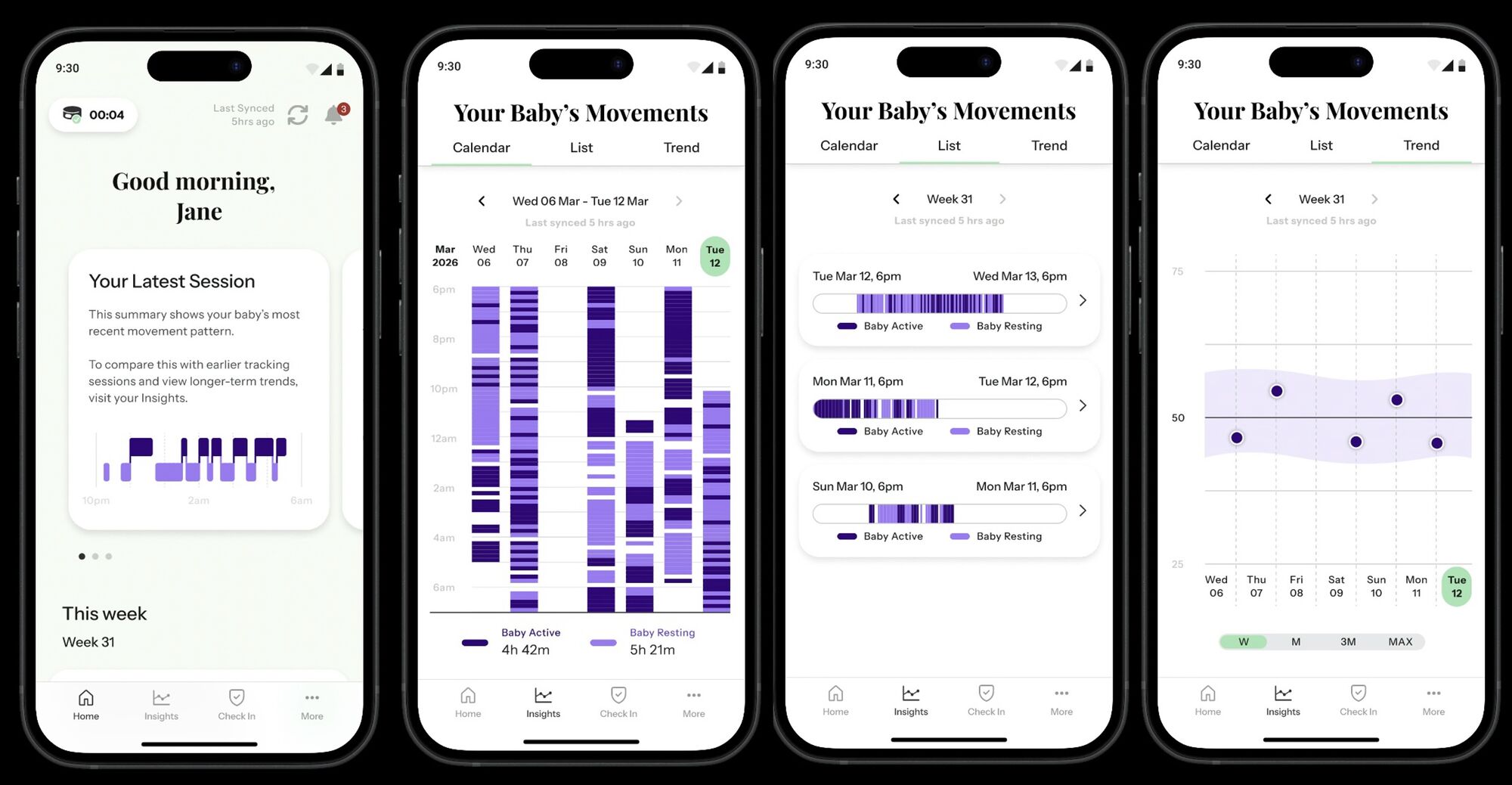
Nightly trends, and notifications designed to flag a sustained change from the baby's own baseline.
FeMo is not a replacement for your own sense of your baby's movements. If you are ever worried about your baby's movements, contact your maternity unit or healthcare provider straight away.
Why movement matters
A change in movement can be an early warning sign.
Reduced fetal movement is one of the most common reasons pregnant people contact maternity services. A 2023 meta-analysis of 39 studies, including more than 720,000 participants, found that presenting with reduced movement was linked to higher rates of stillbirth and of babies born small for their gestational age.i In an international case-control study, a marked reduction in fetal activity in the two weeks before birth was linked to 14 times higher odds of stillbirth.ii
Large trials that encouraged pregnant people to pay closer attention to movements have not reduced stillbirth rates.
Read about fetal movement awareness studies
Our research so far
Measured in real homes, overnight.
- completed studies
- 2completed studies
- participants
- 100participants
- hours of recordings
- 12,252hours of recordings
- movements felt and logged by participants
- 35,719movements felt and logged by participants
Our research has been funded by Wellcome Leap since 2022, first through its In Utero programme and, since 2025, as a company.
See our publicationsKey finding
Every baby has its own steady level.
Our research suggests activity level holds steady through the third trimester within each pregnancy, and varies widely between pregnancies (manuscript in preparation). That is why FeMo is being designed to compare each baby with its own baseline rather than with population norms.
Next steps
Further studies from 2027.
A dedicated study of movement-detection performance is planned for early 2027. Further studies, including in the US, will use the production design and are intended to support FDA and EU regulatory submissions.
Read our researchReferences
- i.Carroll L, Gallagher L, Smith V. Pregnancy, birth and neonatal outcomes associated with reduced fetal movements: a systematic review and meta-analysis of non-randomised studies. Midwifery. 2023;116:103524. doi:10.1016/j.midw.2022.103524
- ii.Heazell AEP, Warland J, Stacey T, et al. Stillbirth is associated with perceived alterations in fetal activity - findings from an international case control study. BMC Pregnancy Childbirth. 2017;17:369. doi:10.1186/s12884-017-1555-6