
The information gap
We track our sleep, our steps and our heart rate. Not our unborn baby.
Antenatal care checks on the baby at appointments. In between, often for weeks at a time, there is no objective information on how the baby is doing.
Why fetal movement
The one sign of a baby's wellbeing that can be checked every day.
It matters clinically.
A decrease in fetal movement is associated with a higher risk of late stillbirth.iii
It is judged by feel.
Pregnant people are asked to notice changes, with no record and nothing to compare against.
Awareness alone is not enough.
In a large UK trial, raising awareness of reduced movements did not reduce stillbirth and was followed by more inductions and caesareans.iv
What is missing is a measurement.
Each baby has their own normal.
Our research suggests each baby has its own typical activity level in the third trimester, and that this varies widely between babies (manuscript in preparation). FeMo compares each baby with their own baseline, not with population averages.
Our approach
A record of movement, night by night.

01
Wear it overnight
A soft band with a small sensor pod. No gel, no clinic visit.
Illustrative design. FeMo is in development and not available for sale.
02
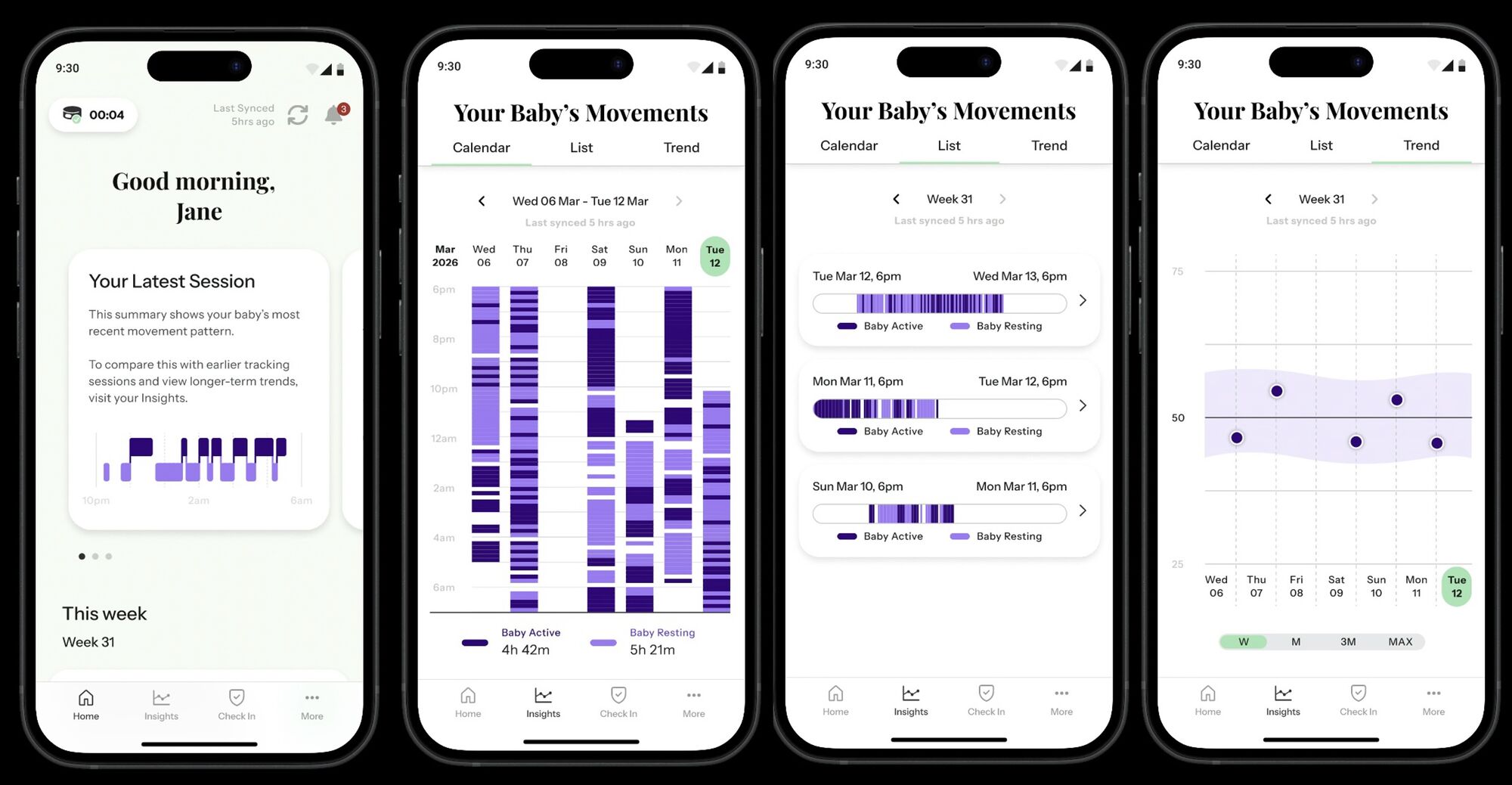
See each night's activity
See your baby's active and resting time each night, and how this week compares with their usual range.
07:12
Tuesday
A change in your baby's usual pattern
Activity over recent nights differs from your baby's own range. Consider contacting your healthcare provider.
Illustrative design. FeMo is in development and not available for sale.
03
A prompt if the pattern changes
FeMo is being designed to notify the user when a sustained change from their baby's baseline is detected, prompting them to contact their healthcare provider.
FeMo is not a replacement for your own sense of your baby's movements. If you are ever worried about your baby's movements, contact your maternity unit or healthcare provider straight away.
Progress
From research to a medical device.
Done
- Funded by Wellcome Leap since 2025, building on research funded through its In Utero programme from 2022 to 2025
- Two clinical studies, 100 participants in total
- Production design built
Now
- Clinical partnership with multiple US hospital sites
- Preparing clinical studies with our new device form factor
Next
- Further studies to show clinical and health-economic benefits
- Planned FDA De Novo submission
>$5m
non-dilutive funding raised by Maternitec
References
- i.National Institute for Health and Care Excellence. Antenatal care. NICE guideline NG201. 2021.
- ii.American College of Obstetricians and Gynecologists. Ultrasound in pregnancy. Practice Bulletin No. 175. Obstet Gynecol. 2016;128(6):e241-e256. Reaffirmed 2022.
- iii.Heazell AEP, Budd J, Li M, et al. Alterations in maternally perceived fetal movement and their association with late stillbirth: findings from the Midland and North of England stillbirth case–control study. BMJ Open. 2018;8(7):e020031. doi:10.1136/bmjopen-2017-020031
- iv.Norman JE, Heazell AEP, Rodriguez A, et al. Awareness of fetal movements and care package to reduce fetal mortality (AFFIRM): a stepped wedge, cluster-randomised trial. Lancet. 2018;392(10158):1629–1638. doi:10.1016/S0140-6736(18)31543-5