
Fetal movement insights
The history of fetal movements
People have been describing babies' movements in the womb for thousands of years. Here's how the ideas have changed - from ancient Greece to Shakespeare and beyond.

Niamh Nowlan, PhD
Co-Founder & CEO, Maternitec
- Published
- Updated
- Read time
- 5 min
Ancient Greek medicine
Some of the earliest medical descriptions of babies moving in the womb come from the Hippocratic writings from ancient Greece. One of them, On the Nature of the Child, claimed that boys start to move at about three months of pregnancy and girls at about four.i Another says that in the last weeks of pregnancy, the baby's movements become "easier and more frequent".ii Aristotle, writing a generation or two later,iii said that boys first move on the right-hand side of the womb "about the fortieth day", and girls on the left "about the ninetieth day". To be fair to Aristotle, he did add that "we must by no means assume this to be an accurate statement of fact, for there are many exceptions".iv
The idea that movements were different between boy and girl babies had serious staying power. Aristotle's Masterpiece, a popular English guide to sex and pregnancy (which Aristotle had nothing to do with!), was still telling readers that a woman carrying a boy "quickens in three months, but going with a female, rarely under four".v The guide stayed in print from 1684 right into the 20th century.vi
While ultrasound studies have found no difference in when boy and girl babies start moving in the womb,vii recent research has looked at whether boys and girls move differently or different amounts. A small study of 31 babies found that boys moved more than girls,viii while a much bigger study of 740 pregnancies found no difference at all.ix So the jury is still out, and as far as we know there's no evidence that pregnant people can tell a baby's sex from its movements.
The two-hearted state
The Charaka Samhita, a founding text of Ayurveda (traditional Indian medicine), reached its present form around the 1st century CE.x It says that once the baby's senses have formed, it starts to stir - the Sanskrit word spandate is translated as "shuddering" - and to express wishes carried over from earlier lives. This is called dauhrida, the "two-hearted" state (what a beautiful phrase!). The baby's heart was thought to be joined to its mother's, so her cravings were really the baby's wishes, and should be met.xi
Religious texts
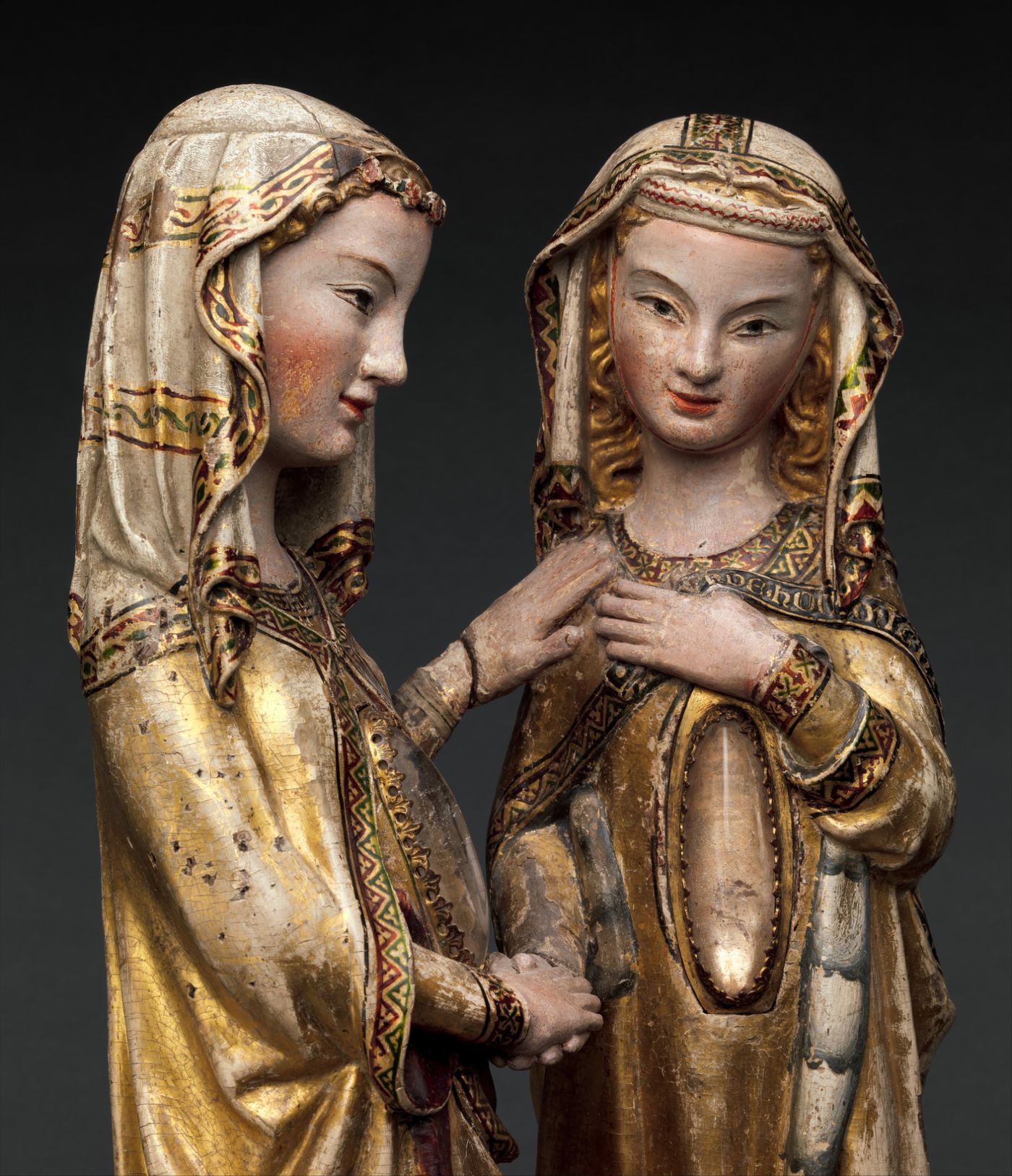
Babies' movements also feature in religious texts. The Book of Genesis, part of both the Hebrew Bible and the Christian Old Testament, draws on traditions that scholars date from roughly the 10th to the 5th century BCE.xii It tells how Rebekah's twins "struggled together within her".xiii In the Gospel of Luke, written in the second half of the 1st century CE,xiv Elizabeth's unborn son John "leaped for joy" when she heard the greeting of Mary, the mother of Jesus.xiii
Quickening and the law
In the English language, the first movements a pregnant woman feels have long been called "quickening", from an old meaning of "quick" - alive.xv And for centuries English law took quickening very seriously indeed. From at least 1228 until 1931, a woman in England who was sentenced to death could "plead the belly". If she was found to be pregnant, her execution was postponed until after the birth, but often not carried out afterwards. Some women were pardoned, and others had their sentence changed to transportation.xvi From the 14th century on, being pregnant wasn't enough - she had to be "quick with child", meaning the baby was moving.xvixvii
So who decided? A jury of twelve matrons, who were told to handle the woman "about the breasts and the belly in all ways".xvii As you can imagine, their verdicts weren't always reliable. In Norwich in 1833, a jury of matrons decided that Mary Wright was not "quick with child". Three local doctors then examined her and found that she was. She was reprieved, and gave birth to a daughter on 11 July that year.xvixviii The rule finally ended with the Sentence of Death (Expectant Mothers) Act 1931.xvi
A kick in the language
Quickening also made its way into everyday speech. In Shakespeare's Love's Labour's Lost, first printed in 1598, the clown Costard announces that Jaquenetta is pregnant with the line "shee's quicke, the childe bragges in her bellie already".xix
What the kicks are telling us
Looking back, people have long read meaning into a baby's movements - whether it's a boy or a girl, whether it's happy, even what it wants for dinner. For centuries, quickening was also one of the few sure signs that a baby existed at all, and only the pregnant woman herself could feel it.xx
A lot has changed since then. Scans can now show a baby moving from around 7 weeks of pregnancy,xxi long before anyone can feel it. But the sensation of a baby's kicks is something pregnant people have shared throughout history, and for many it's still one of the most special aspects of pregnancy.
© 2026 Maternitec Ltd. You're welcome to share a link to this article. Please don't reproduce it without permission.
References
- i.Bourbon F. Predicting and choosing baby's gender in the Hippocratic Corpus. Medicina nei Secoli. 2017;29(1):51–70.
- ii.Hippocrates. On the seventh-month child 3–4. In: Lefkowitz MR, Fant MB, eds. Women's Life in Greece and Rome. Baltimore: Johns Hopkins University Press.
- iii.Encyclopaedia Britannica. Aristotle. https://www.britannica.com/biography/Aristotle (accessed 24 October 2026).
- iv.Aristotle. The History of Animals, Book VII, ch. 3. Translated by Thompson DW.
- v.Salmon W, ed. The Works of Aristotle the Famous Philosopher (Aristotle's Masterpiece), ch. II. Project Gutenberg eBook 12699.
- vi.Johns Hopkins Magazine. Aristotle's Masterpiece. Summer 2014. https://hub.jhu.edu/magazine/2014/summer/aristotles-masterpiece/
- vii.de Vries JIP, Visser GHA, Prechtl HFR. The emergence of fetal behaviour. III. Individual differences and consistencies. Early Hum Dev. 1988;16:85–103.
- viii.DiPietro JA, Hodgson DM, Costigan KA, Hilton SC, Johnson TRB. Fetal neurobehavioral development. Child Dev. 1996;67(5):2553–2567.
- ix.DiPietro JA, Costigan KA, Voegtline KM. Studies in fetal behavior: revisited, renewed, and reimagined. Monogr Soc Res Child Dev. 2015;80(3):vii–94. doi:10.1111/mono.v80.3
- x.Encyclopaedia Britannica. Charaka. https://www.britannica.com/biography/Charaka (accessed 24 October 2026).
- xi.Charaka Samhita, Sharira Sthana 4.15. Translated by Gehlot S, Singh BM, Gujarathi J. Charak Samhita New Edition. 2020. doi:10.47468/CSNE.2020.e01.s04.005
- xii.Encyclopaedia Britannica. Genesis. https://www.britannica.com/topic/Genesis-Old-Testament (accessed 24 October 2026).
- xiii.The Holy Bible, New Revised Standard Version Updated Edition. Genesis 25:22; Luke 1:44. 2021.
- xiv.Encyclopaedia Britannica. Saint Luke: Luke's writings. https://www.britannica.com/biography/Saint-Luke/Lukes-writings (accessed 24 October 2026).
- xv.Online Etymology Dictionary. Quicken. https://www.etymonline.com/word/quicken (accessed 24 October 2026).
- xvi.Forbes TR. A jury of matrons. Med Hist. 1988;32:23–33.
- xvii.Butler SM. More than mothers: juries of matrons and pleas of the belly in medieval England. Law Hist Rev. 2019;37(2):353–396. doi:10.1017/S0738248018000664
- xviii.Clifford N. The Norfolk murders, part 1: Mary Wright. https://www.naomiclifford.com/norfolk-murders-mary-wright/ (accessed 24 October 2026).
- xix.Shakespeare W. Love's Labour's Lost, Quarto 1 (1598), Act 5, Scene 2. Billings T, ed. Internet Shakespeare Editions.
- xx.Fox S. Giving Birth in Eighteenth-Century England. London: University of London Press; 2022. Chapter 1, Birth and the body.
- xxi.Luchinger AB, Hadders-Algra M, van Kan CM, de Vries JIP. Fetal onset of general movements. Pediatr Res. 2008;63(2):191–195.